← All Series
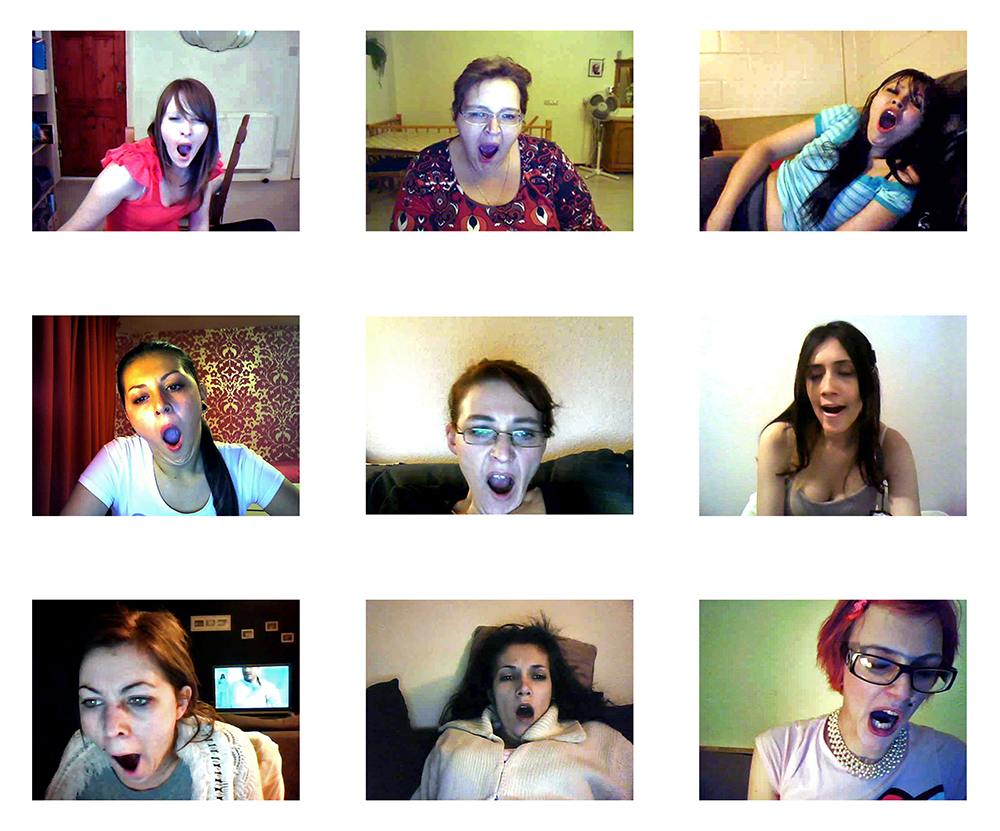
Users, yawning
THE USERS: On the Abstraction of Identity and the Paradox of Photographic Proximity
Privacy, Visibility, and the Figure of the User in Network Culture
Summary:
THE USERS is a photographic series made entirely without a camera in the conventional sense. Working from a distance - physically remote, yet networked - the photographer accessed unsecured private webcams distributed across the internet and extracted still images from their live feeds. No physical presence in any of the spaces depicted: the work was made from a desk, through a screen, via the infrastructure of a connected world.
The process is deceptively simple in its mechanics and radical in its implications. A webcam inadequately protected against external access becomes, in effect, a publicly available lens - one that continues to record the private life of its owner regardless of whether that owner is aware of being seen.
By locating and observing these feeds, the photographer found subjects who were not performing for the camera, not posing, not conscious of being photographed at all.
The images that result carry a quality of unguarded ordinariness that conventional portraiture rarely achieves: people at home, in motion, absorbed in the textures of daily life.
This method inverts the usual logic of photography. Proximity - the physical closeness of a photographer to a subject that has historically defined the documentary tradition - is here replaced by its opposite. Distance becomes the condition of intimacy. The further the photographer from the scene, the more candid, the more unmediated, the more genuinely private the image. The web, understood in this way, functions as a vast and largely unwatched camera - a planetary network of lenses embedded in bedrooms, kitchens, offices, and hallways, producing an unbroken stream of images that mostly pass unseen.
THE USERS is, among other things, an act of making visible what the language of digital culture systematically conceals. The term 'user' abstracts the individual into a category, strips away particularity.
This series does the opposite: it restores faces, spaces, moments. It insists on the singularity of the people behind the term.
.
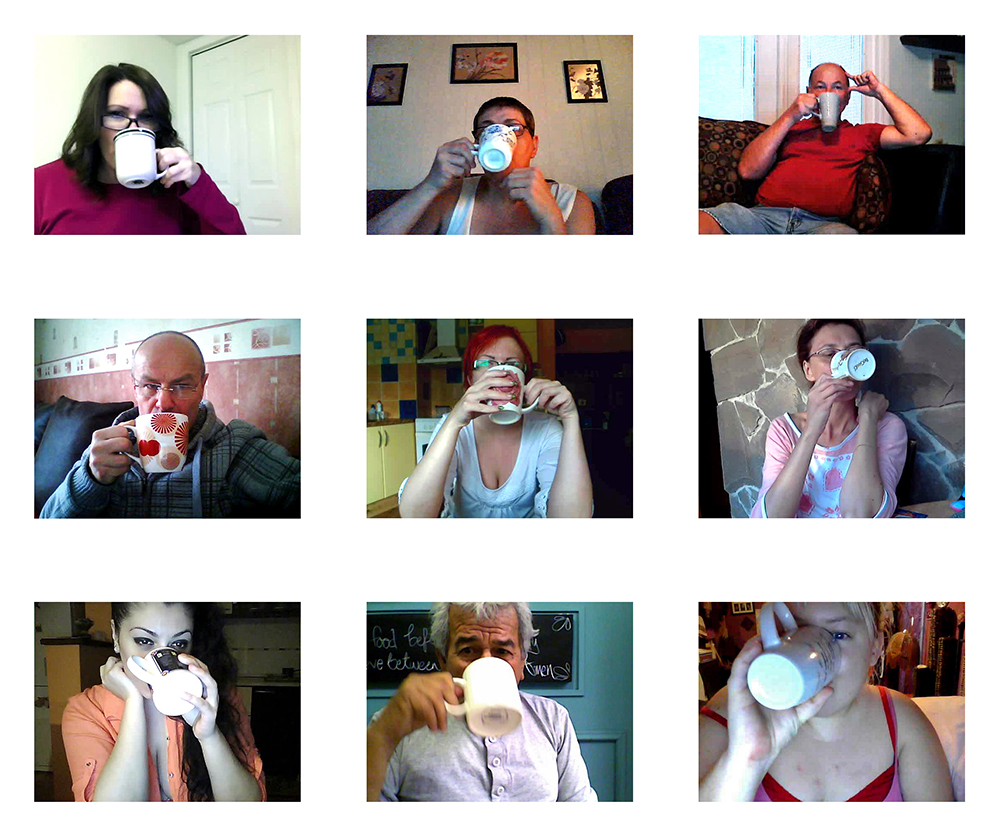
User, Cup
1. The User as Abstraction
A web image search for the term "user" returns icons only - schematic graphic symbols. The user does not exist, at least not in pictures.
This is, upon reflection, a remarkable fact. Few concepts are as pervasive in the language of the contemporary internet as that of the user; it appears in terms and conditions, in interface design, in product development, in data protection law, in marketing, and in political discourse. And yet, when one attempts to give this term a face, the result is nothing more than an abstraction - a cipher, a stand-in for an indefinite multiplicity.
This paradox is not incidental. The figure of "the user" - like that of "the customer" or "the consumer" - functions precisely as an abstraction, a conceptual vessel into which any individual may be poured and from which any individual may be extracted without remainder. The singular definite article - "the" user, "the" customer - implies a coherent subject, yet in practice denotes no one in particular.
It is a rhetorical convenience: a way of speaking about people in the aggregate while simultaneously obscuring the irreducible particularity of each individual person. Behind the term, real human beings disappear into a statistical category, their specific identities, vulnerabilities, desires, and histories dissolved into a generalized profile of behaviour and preference.
This abstraction is not merely linguistic. It has profound consequences for how digital systems are designed, how data is collected, and how individual rights - including the right to privacy - are negotiated and, all too frequently, eroded.
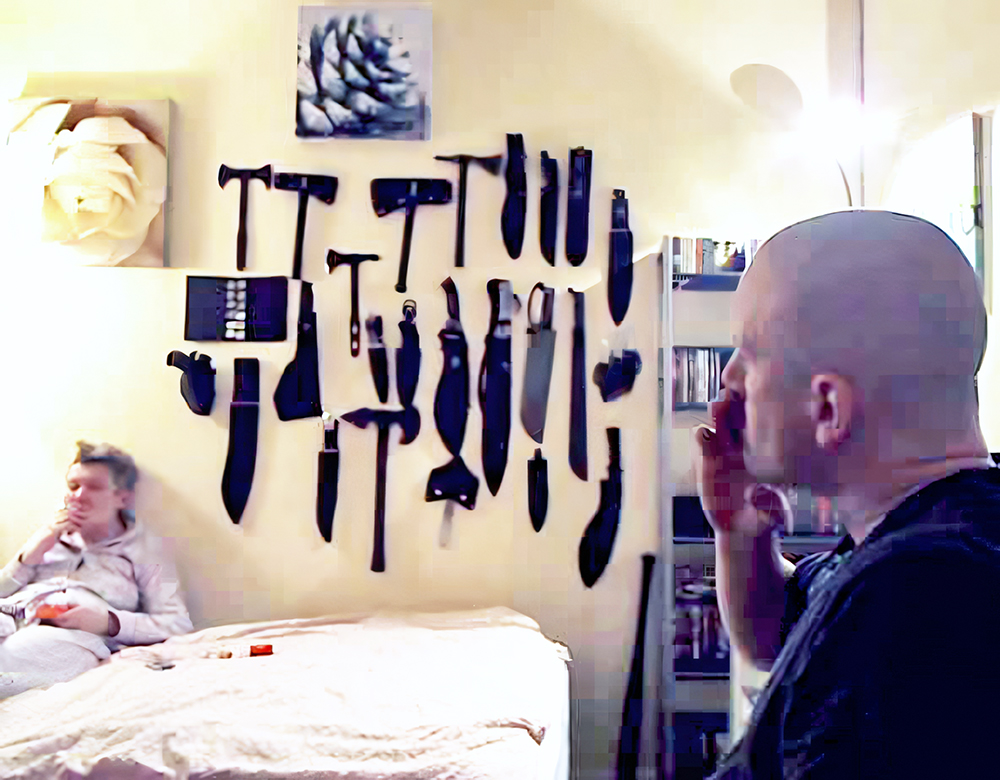
User 62
2. The Webcam as Medium of Self-Presentation
Private webcams presumably serve some form of communication and self-assurance: they enable video calls, remote monitoring, social livestreaming, or simply the background presence of a connected camera in a domestic space. In their ideal function, they become, over time, entirely absorbed into the rhythms and textures of daily life. The person living with a webcam begins to behave towards it much as one might towards a low-maintenance, if somewhat neurotic, household pet - acknowledged but not constantly attended to, present but rarely the focus of deliberate performance.
This habituation is significant. It means that the webcam, unlike the portrait studio or the professional photographic session, does not produce images of people performing for the camera; it produces images of people simply living, often without awareness that they are being seen. In this sense, the webcam occupies a unique position in the history of photographic image-making: it is a technology that renders the intimate and the unguarded visible, not through the intrusion of a photographer into a space, but through the subject's own gradual forgetting that the camera is there at all.
3. Privacy, Exposure, and the Consented Gaze
The decision to install a webcam in a private or semi-private space is, in most cases, a voluntary one - a choice made by the individual in the expectation of some utility or connection.
Yet the nature of digital networks means that this choice carries risks that are rarely fully understood at the moment of installation. An inadequately secured webcam does not remain a private instrument; it becomes a node in a global network of potentially accessible image streams, visible to anyone with the technical means and inclination to look.
The concept of privacy that is at stake here is not reducible to legal categories of data protection, though those are relevant. It is, more fundamentally, the right of individuals to control the conditions under which they are seen - to determine, for themselves, when they are visible, to whom, and in what context.
The ubiquitous abstraction of "the user" actively works against this right: it groups individuals into undifferentiated masses, strips them of their particular circumstances, and treats their image data as a resource to be managed, monetised, or - as the webcam projects explored here demonstrate - accessed and repurposed by others.
The gap between the legal subject of privacy law and the lived experience of being seen without knowing it is one of the defining tensions of contemporary digital culture.
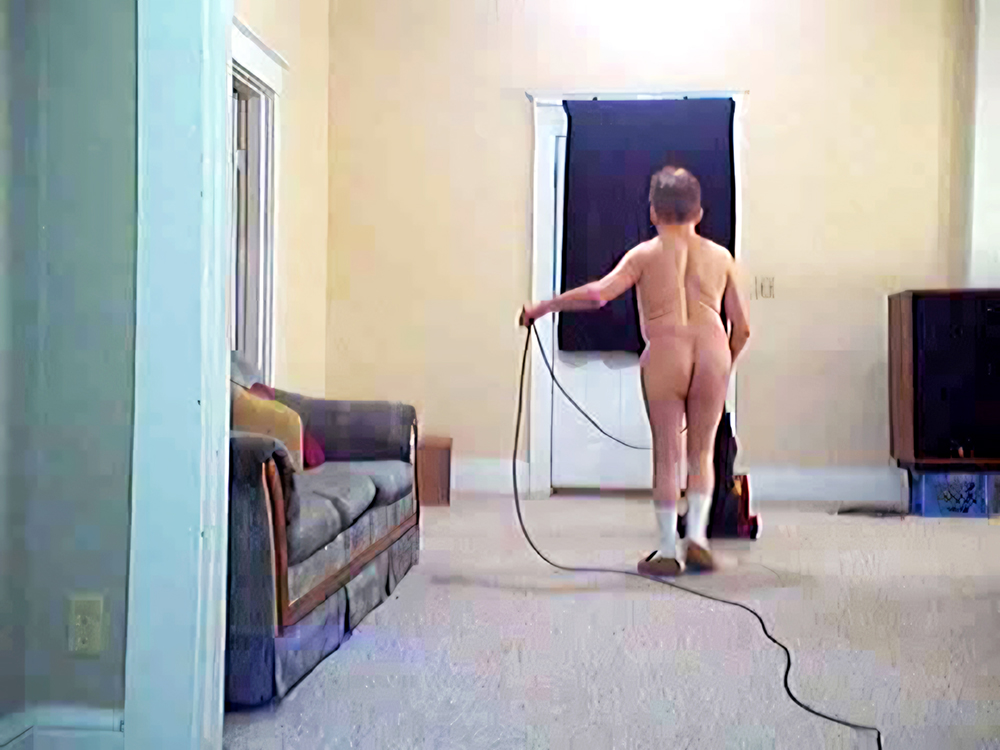
User 1558
4. Photography Through the Medium: Distance and Intimacy
The photographic project THE USERS addresses this condition with a distinctive methodological and conceptual gesture. By accessing unsecured private webcams and extracting images from their feeds, it produces a body of portraits - if they can be called that - of people who did not pose, did not consent, and in many cases were entirely unaware of being photographed. The photographer was, in the conventional sense, absent: there was no physical intrusion, no negotiation, no presence in the room. And yet the resulting images are, paradoxically, intimate in a way that much conventional portraiture is not. The subjects are unguarded, immersed in the textures of their ordinary lives, behaving not for an observer but simply as themselves.
This produces the central paradox that the project articulates: the further away one is from the people, the closer one gets to them. Physical distance - the distance imposed by the network, by the screen, by the technical mediation of the webcam - does not produce alienation but its opposite. It is precisely because the photographer is remote that the subjects are present without performance, intimate without intention.
This inversion of the conventional relationship between proximity and knowledge is one of the most striking aspects of the project, and it raises questions that extend well beyond the domain of photography: what does it mean to know someone, to see someone, in an age when the most candid images of a person may be those taken without their knowledge, from thousands of miles away?
5. The Web as Camera: New Territories of the Photographic
THE USERS can be understood as a contribution to an ongoing renegotiation of the boundaries of photography as a medium. The web, in the context of this project, functions as a vast, distributed camera - a network of lenses, each embedded in a private space, each producing a continuous stream of images that, under normal circumstances, flow unseen. The photographer's role becomes not that of someone who enters a space and makes a picture, but of someone who navigates an informational infrastructure and extracts images that already circulate, already constitute a form of visual documentation of the lives of their subjects.
In this sense, the project pushes photography into territories it has not previously explored: the territory of the network, the territory of the uninvited gaze, the territory of the image that is made not by a human hand directing a lens but by the ambient logic of a connected world.
This expansion of the photographic carries with it a corresponding expansion of the ethical questions photography has always posed. The history of documentary and street photography is, in part, a history of debate about the ethics of capturing the unguarded - of the right to photograph strangers, of the relationship between photographer and subject, of the uses to which images of private individuals may legitimately be put.
THE USERS does not resolve these questions; it intensifies them. By making visible the faces that the abstraction of the user conceals - by giving particularity to what had been rendered generic - it performs an act of disclosure that is simultaneously an act of violation. That this tension is irresolvable is, perhaps, precisely the point.
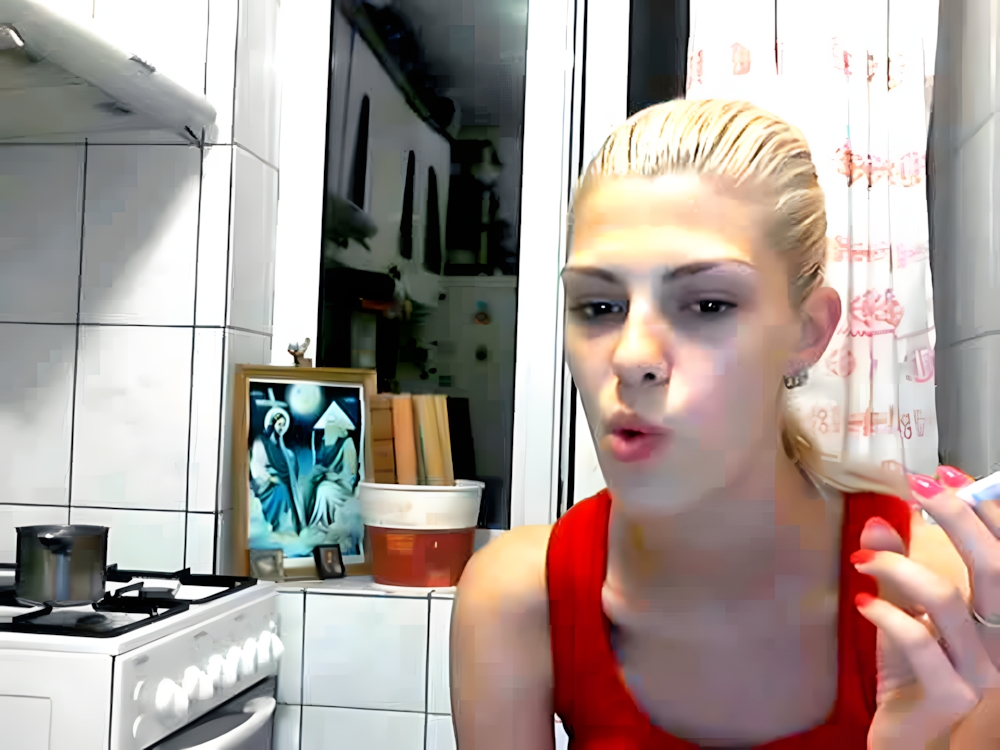
User 218
6. Conclusion
The figure of "the user" is one of the most consequential abstractions of our time. It enables the construction of vast digital systems premised on human behaviour while systematically obscuring the humanity of the individuals whose behaviour it describes.
THE USERS responds to this abstraction not with argument but with images: images of real people, in real spaces, living real lives - people who happen, by virtue of their webcams and the vulnerabilities of the network, to have become momentarily visible to a photographer who was never in the room. In doing so, the project illuminates both the extraordinary intimacy that digital mediation can produce and the profound questions about privacy, consent, and the ethics of the gaze that this intimacy demands we confront.
Keywords: user, privacy, webcam, digital photography, surveillance, abstraction, intimacy, network culture, the gaze, photography ethics
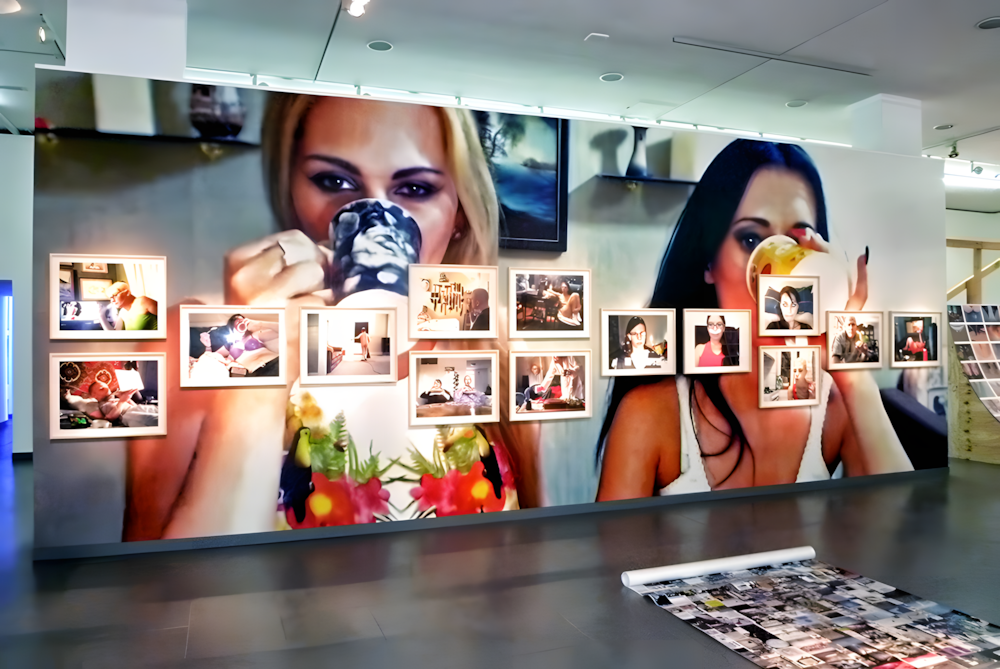
THE USERS, exhibition view, NRW Forum, Duesseldorf (D): EGO Update